HealMind
Designing a configurable collaborative-care EHR from the ground up

HealMind needed a custom EHR because existing EHR and CRM products did not fit its operating model. The company works with partner clinics delivering ketamine-assisted treatment, so the platform needed to support day-to-day clinical operations at the clinic level while giving HealMind the administration, visibility, reporting, and governance required across the network.
The engagement began with an audit of an early offshore design effort. I identified where the existing direction was not solving the right problems, then reset the product approach with the CEO and CTO. What began as a small set of initial screens became a much larger 0→1 platform: more than 300 unique screens across clinical records, charts, scheduling, telehealth, billing, referrals, analytics, administration, and more.
0→1 Product Strategy and UX Strategy
EHR Information Architecture and Workflow Design
Clinical Records, Charting, and Patient Management
Multi-organization Hierarchy and Role-based Permissions
Scheduling, Telehealth, Billing, Referrals, Forms, and Communications
Analytics, Reporting, and Administrative Tools
UX/UI Design, Design Direction, and Design-system Foundations
Scope
Role & Ownership
I led the product strategy and design direction throughout the engagement. I worked directly with HealMind's CEO and CTO to translate an emerging healthcare business model into a usable platform, define the underlying UX framework, architect the user journeys, establish the visual and interaction direction, and solve critical product questions as they surfaced.
I was a key driver of the product thinking and core design direction. I set the direction for the EHR's workflows, role and permission model, hierarchy, look and feel, and operating patterns, then reviewed and redirected work continuously as designs developed and stakeholder feedback arrived. When a proposed solution did not fit the product or did not meet the client's needs, I created and directed the revised approach in the work sessions themselves.
The Real Problem
The product had to support a high-stakes conversation without expecting ordinary people to understand the language of financial modeling. Information such as income sources, expenses, investable assets, advisor fees, average return, downside volatility, and maximum drawdown can be difficult to interpret in isolation. Yet that information needed to be gathered accurately enough to drive a meaningful score and a recommended scenario.
At the same time, this was not only a client questionnaire. Advisors needed an operational workspace: a way to manage new leads, prospects, and clients; see a person’s progress; identify missing information; review client data; and control whether someone could view or edit it.
The central design challenge was to connect those two sides of the product. The intake, advisor workflow, and client-facing score could not feel like separate tools. They needed to form one understandable path from first conversation to next step.
What Mattered Most
The first priority was making a complex financial intake feel manageable. I organized the self-service flow into clear sections—general information, safety questionnaire, income sources, expense sources, investable assets, and current advisor fees—so people could work through the information in smaller, understandable steps.
The second was explainability. A score alone would not help a client understand what was changing or why. The experience needed to make the comparison between a current scenario and a recommended scenario legible, while providing plain-language help around concepts that might otherwise be unfamiliar.
Finally, the advisor needed to remain effective throughout the process. The product had to accommodate an advisor guiding the conversation live as well as clients completing information on their own time, then give advisors an organized way to pick the conversation back up.
Key decisions
I reset the product direction through an audit
I started by evaluating the early design work against the actual operating needs of the product. Rather than extending an incomplete set of screens, I used the audit to identify missing workflows, weak assumptions, and places where the solution would not scale. That created the foundation for a more complete product strategy and a clear path forward with the CEO and CTO.
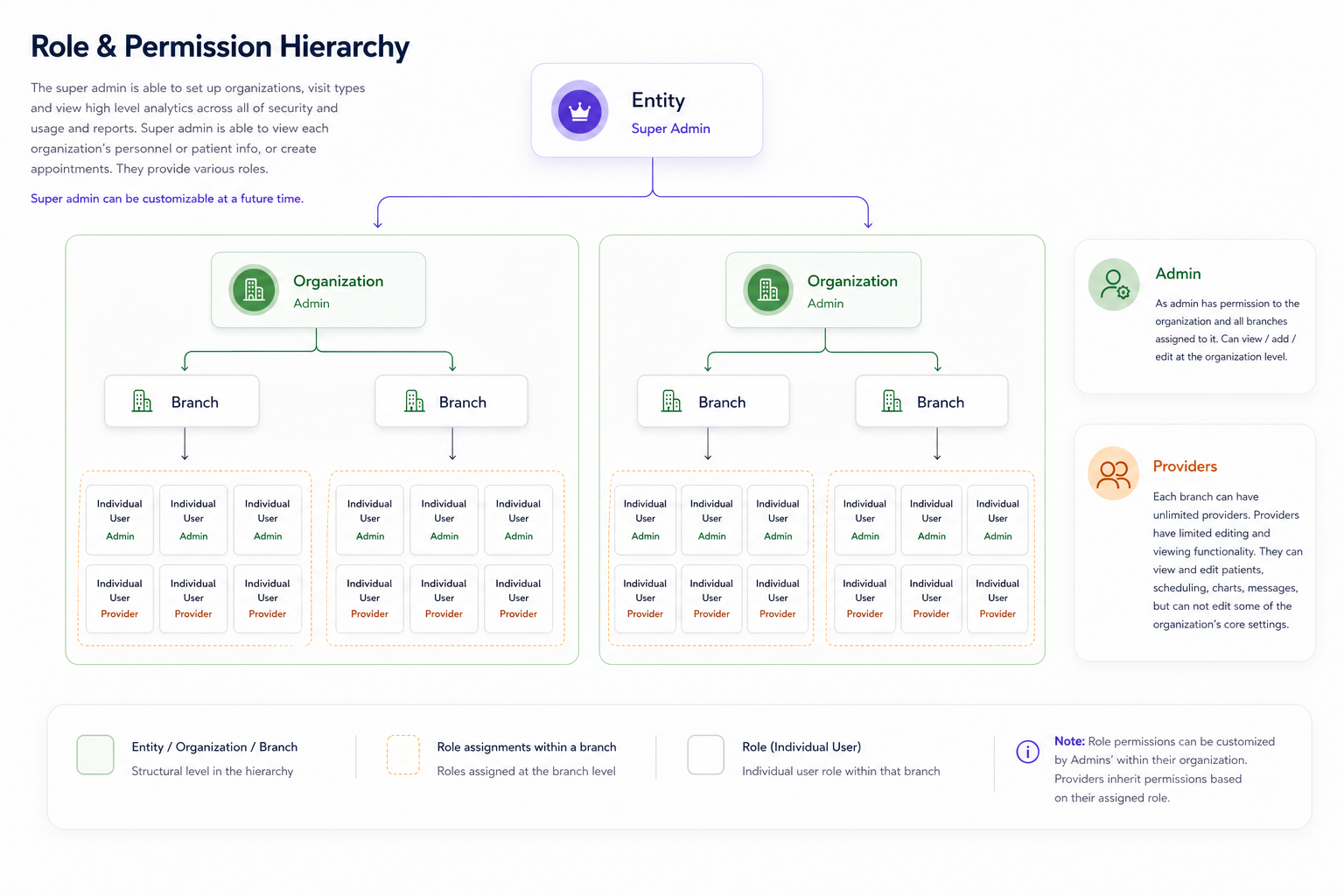
I established the organization, role, and permission model
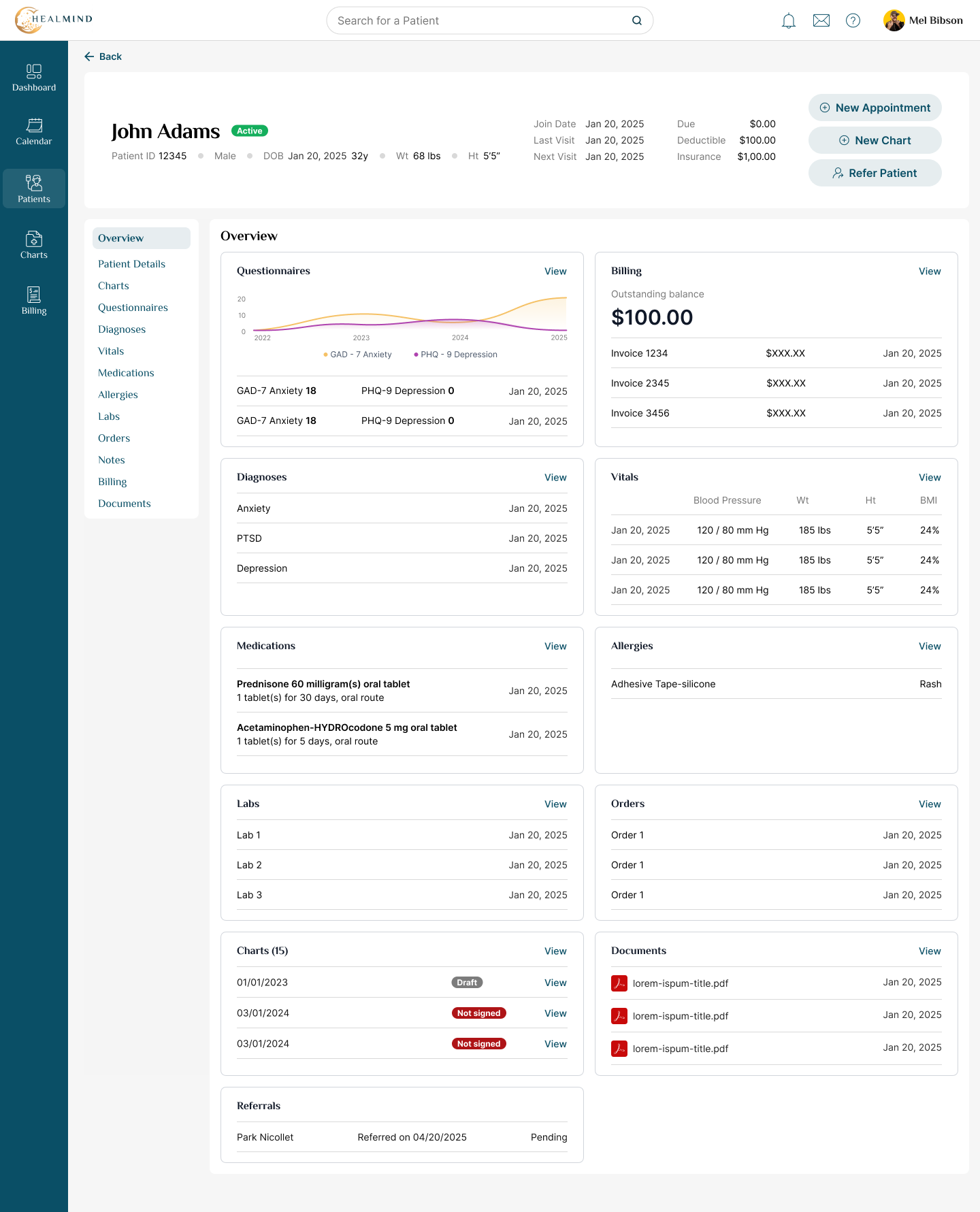
I designed the platform around a hierarchy that could support HealMind, partner organizations, locations, providers, administrators, and patients. The role model differentiated provider, admin, super-admin, and patient experiences, then connected those roles to specific permissions and actions. This made the system configurable while preserving the controls required for a healthcare platform.
I translated clinical operations into connected workflows
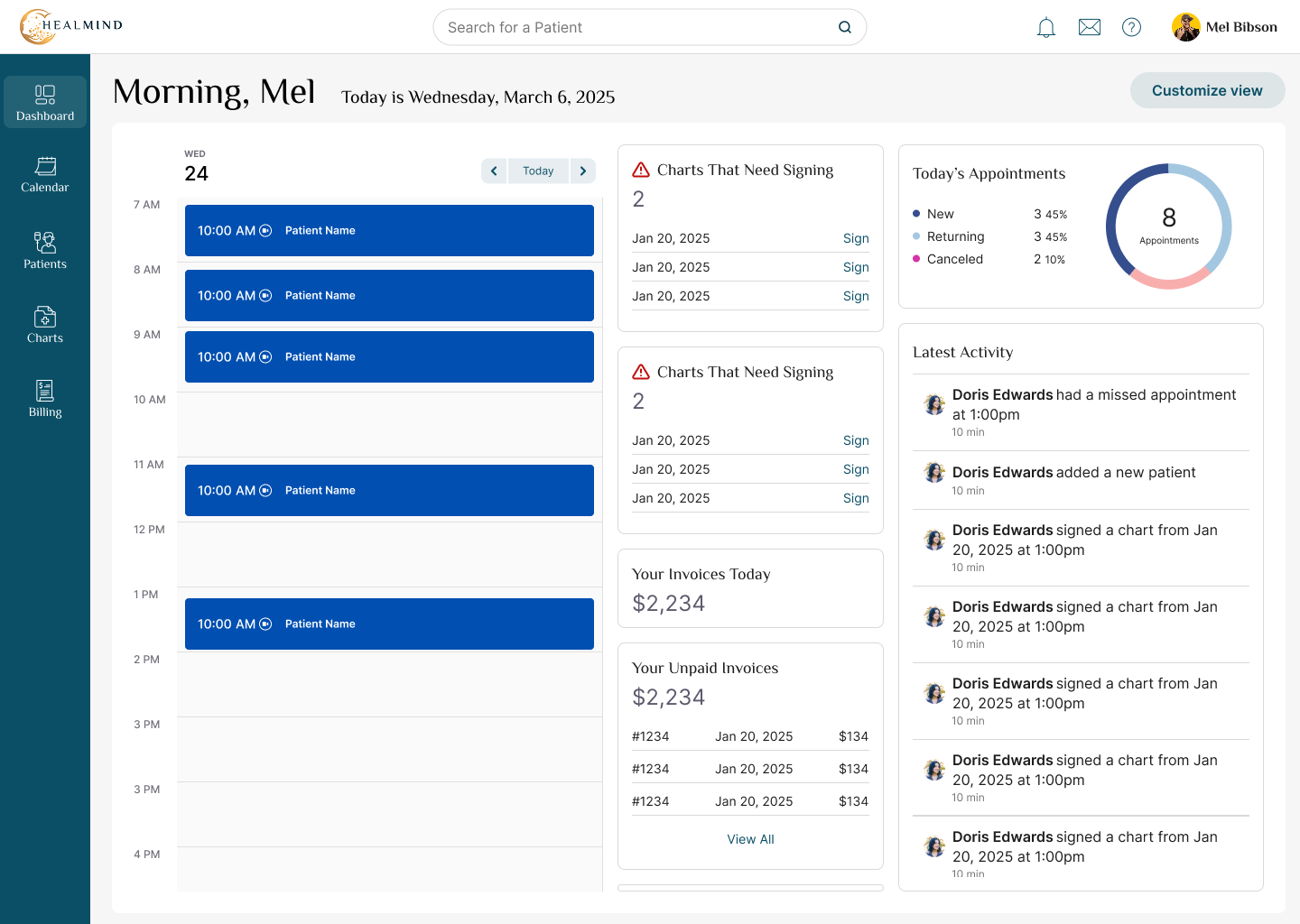
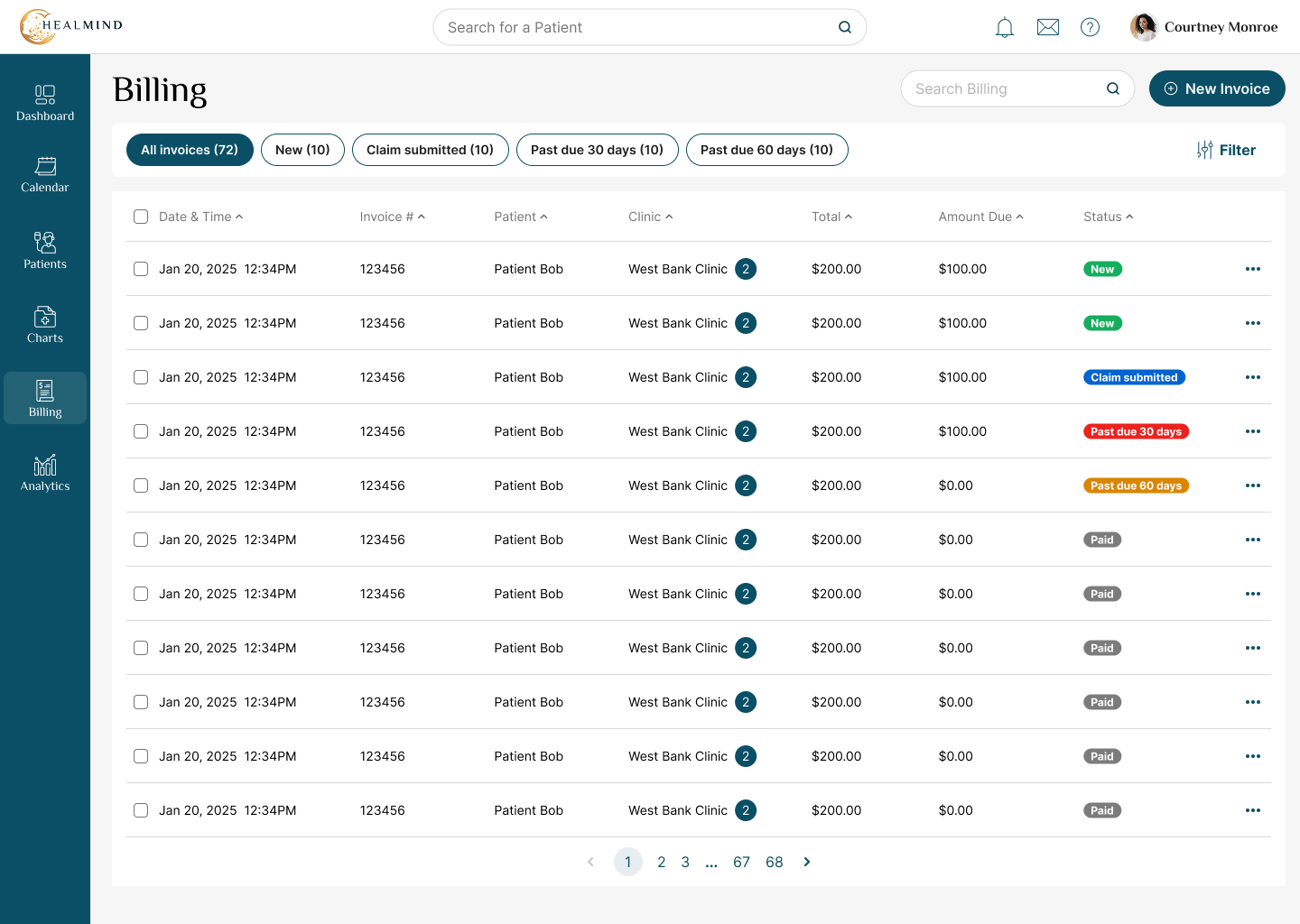
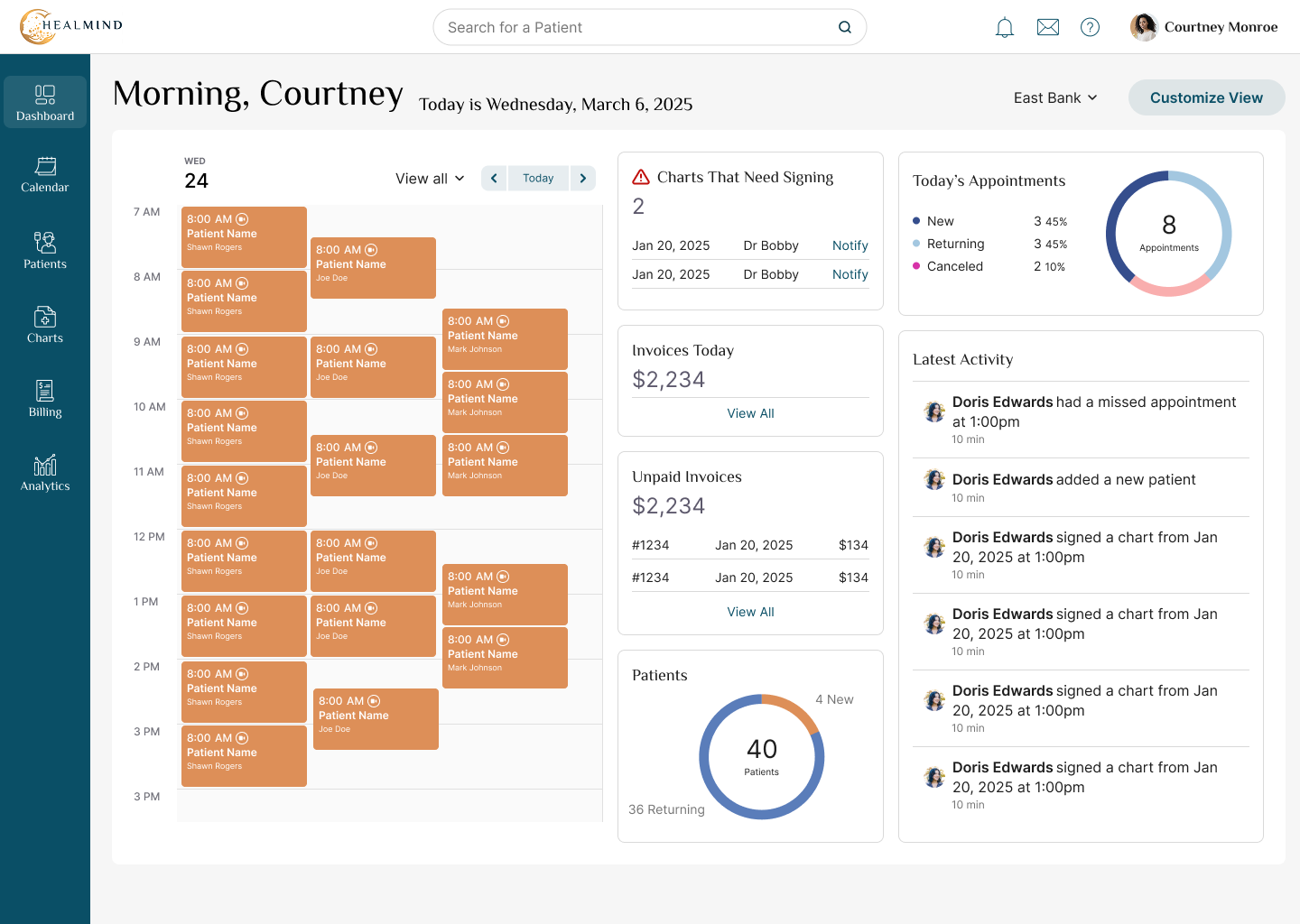
I designed the core experience around the work clinic teams needed to do: manage patients, review and create charts, schedule appointments, support telehealth, capture forms, coordinate referrals, issue invoices, manage billing, and communicate with the right people. I also connected those operational workflows to patient history, treatment information, task progress, notifications, and supporting documentation so each role could move through the system without losing context.
I gave HealMind network-level management without taking operations away from clinics
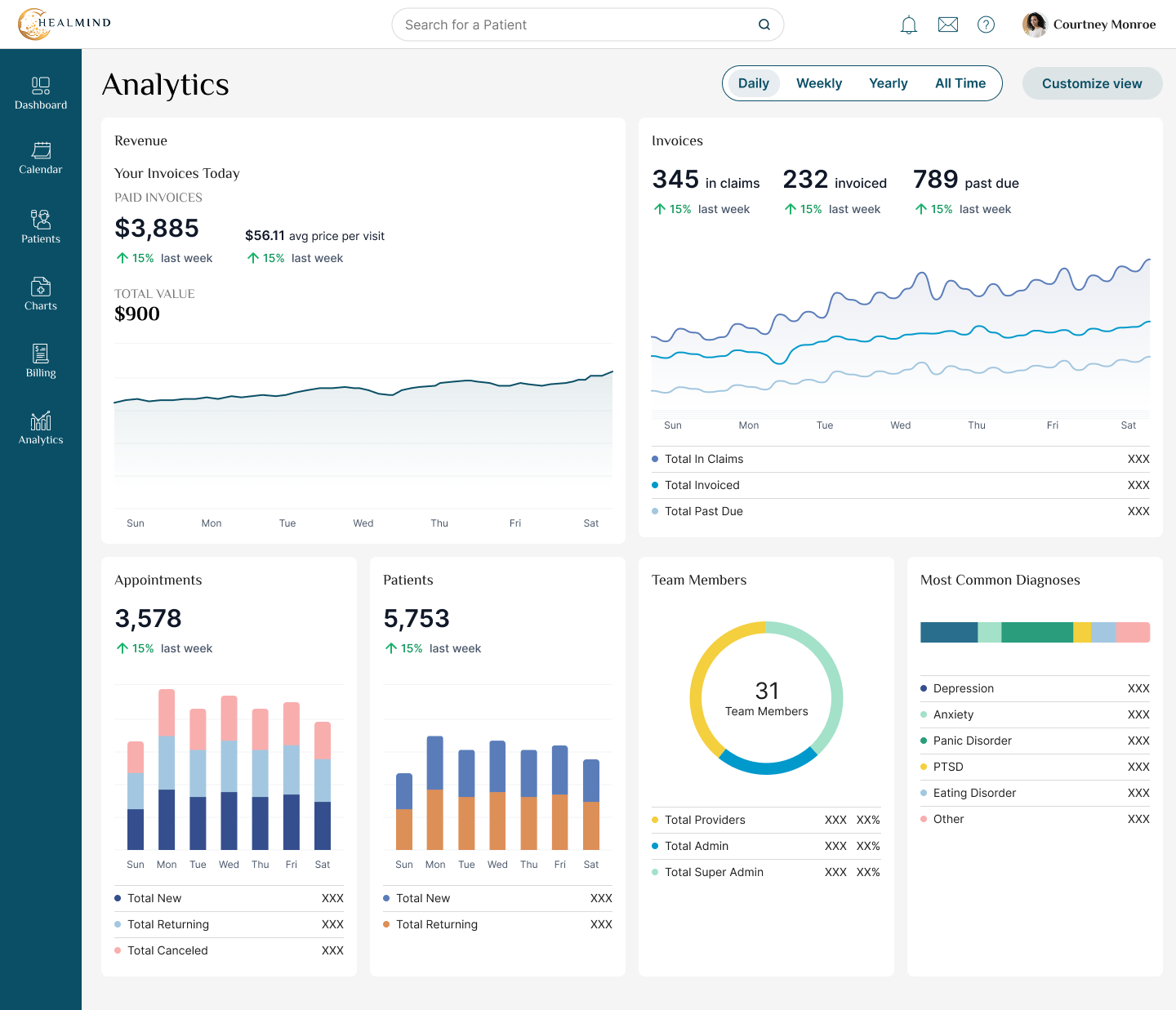
I designed administrative experiences for organization setup, team management, security, settings, analytics, custom reports, and activity history. The goal was to give HealMind the ability to manage the network and understand its performance while allowing each partner clinic to operate within its own organization and workflows.
I built a scalable product language across more than 300 unique screens
The scope grew far beyond the initial design effort. I established the UX and visual direction that carried across more than 300 unique screens, excluding conditional variants and states. Shared patterns and design-system foundations helped keep records, charts, dashboards, scheduling, billing, reporting, and settings coherent as the product expanded.
Outcome
The work resulted in a stakeholder-approved design prototype and an engineering handoff for a full collaborative-care EHR. The final design scope included more than 300 unique screens, not including conditional variants or states, and established a complete product direction across clinical, operational, administrative, and reporting workflows.
The documented outcome is a complete, stakeholder-approved 0→1 platform design that moved HealMind from an inadequate early direction to an engineering-ready product vision.